

If you’re staring in the mirror and wondering whether to try Botox or fillers or looking for a comparison of Botox vs Fillers, you’re not alone. Both are among the most popular non-surgical treatments for refreshing your look, but they work in totally different ways.
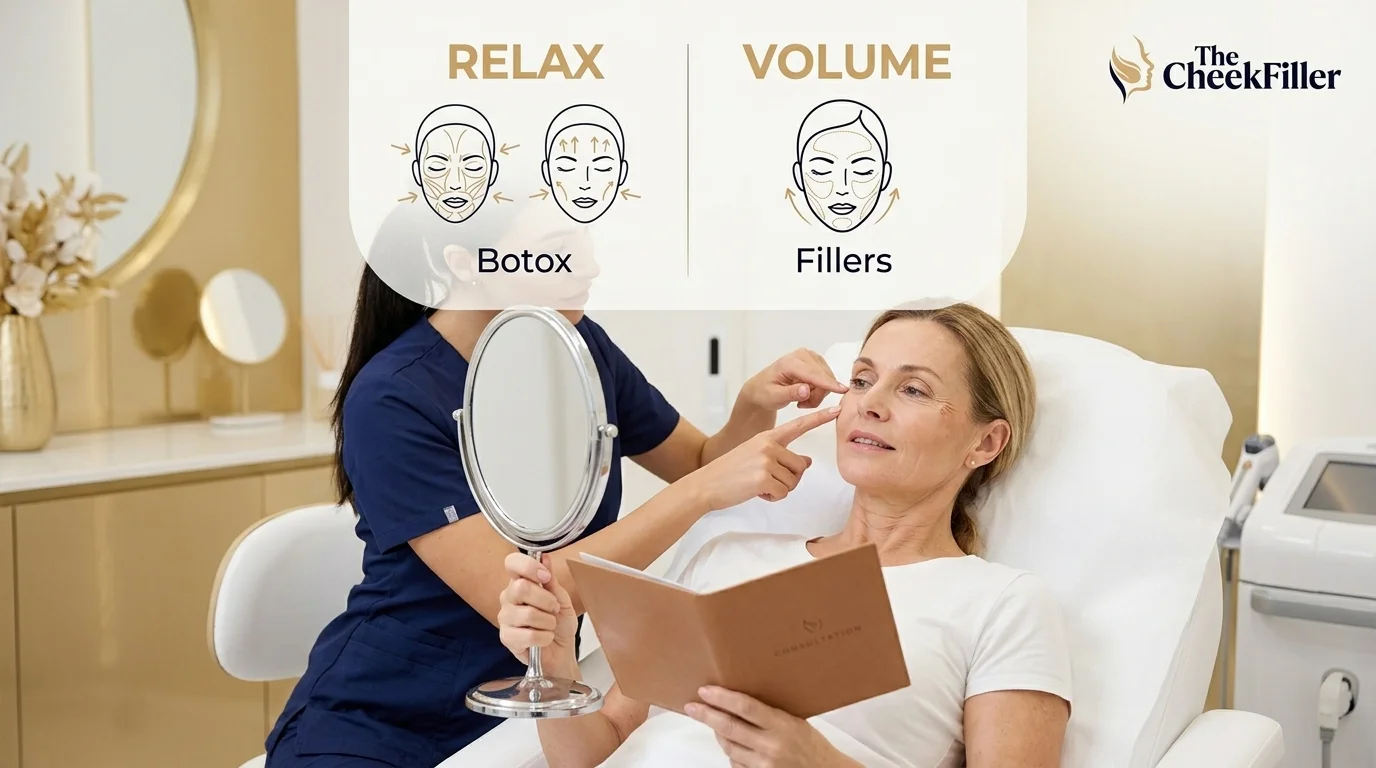
Think of it this way: Botox smooths wrinkles caused by movement, like forehead lines, frown lines, and crow’s feet, by relaxing the muscles underneath. Fillers, on the other hand, restore lost volume and fill in deeper folds, hollow cheeks, thin lips, and static wrinkles that show up even when your face is at rest.
In short:
- Choose Botox if your main concern is dynamic wrinkles from repeated expressions.
- Choose fillers if you want to add volume, lift contours, or smooth deeper lines.
Many patients actually combine both for a more balanced, natural result. The best choice depends on your goals, anatomy, and how long you want the results to last. Stay connected for more details.
What Is Botox and How Does It Work?
Botox is a purified form of botulinum toxin type A that’s been used safely for decades to smooth expression lines and, in some cases, treat medical conditions like chronic migraines or overactive muscles. In cosmetic care, it’s best known for softening forehead creases, frown lines, and crow’s feet. Those little wrinkles that deepen when you talk, smile, or concentrate.
People often call it “Botox,” but the broader category is neuromodulators. Other brands in this group include Dysport (abobotulinumtoxinA) and Xeomin (incobotulinumtoxinA). They work the same way, with subtle differences in diffusion and dosing that your injector considers when planning treatment.
The thing most guests get right is this: Botox doesn’t fill anything. It relaxes. If your lines appear mostly when your face moves, Botox is usually the smarter first step.
How Does It Work?
Botox temporarily blocks the signal from nerve to muscle. When that signal is reduced, the muscle contracts less, and the skin above it relaxes. Over days, those “active” lines soften. With time, the pattern of repeated movement changes, and many people notice they need fewer units to maintain the same look.
- When it starts: You’ll typically notice a change in 3–5 days.
- Peak effect: Around 10–14 days.
- Duration: Most patients see results last 3–4 months; some areas (like the forehead) may fade a bit sooner, while others can stretch closer to 4–5 months.
What Are Dermal Fillers and How Do They Work?
Dermal fillers are gel-like substances injected under the skin to restore volume, lift contours, and smooth static lines that show even when your face is at rest. While Botox relaxes muscles, fillers physically “fill”, think plumping thin lips, lifting hollow cheeks, softening deep nose-to-mouth lines, and refining the jawline. The most common type is hyaluronic acid (HA), a sugar-based molecule your skin already produces that holds water and keeps tissue hydrated.
Popular HA brands include Juvederm, Restylane, and Belotero, each engineered with different firmness and stretch for specific areas. For example, some gels are soft and flexible for lips, while others are firmer for cheekbones or the jaw. There are also non-HA fillers like poly-L-lactic acid (Sculptra) and calcium hydroxylapatite (Bellafila), which work by stimulating your own collagen over time. But HA remains the go-to for immediate, reversible results.
Fillers shine when your goal is reconstruction rather than relaxation: restoring lost volume from aging, weight change, or genetics, and smoothing folds that don’t disappear with muscle relaxation alone.
How Does It Work?
HA fillers act like a sponge under the skin. They bind to water, swelling slightly to lift and support the tissue above. This instantly fills hollows, softens lines, and improves contour. Because HA is reversible, if you ever want an adjustment, an injector can dissolve it with an enzyme called hyaluronidase, a safety feature many patients appreciate.
- When you see results: Immediately, with a bit of settling over 2–3 days.
- Duration: Typically 6–12 months for most areas; lips often last 6–9 months, while cheeks and jawline can stretch to 12+ months depending on the product and technique.
- Downtime: Mild swelling or tenderness for 24–48 hours is common; bruising can happen but is usually subtle.
Botox vs Fillers: Key Differences at a Glance
When you’re deciding between Botox vs fillers, the simplest rule is: Botox relaxes movement-based lines, while fillers restore volume and smooth static folds. That difference shapes everything, what each treats, how long it lasts, downtime, and even cost.
Below is a clear, practical comparison to help you choose the right treatment for your goals.
| Feature | Botox (Neuromodulator) | Dermal Fillers (HA & Others) |
| What it does | Temporarily relaxes facial muscles | Adds volume, lifts contours, fills lines |
| Best for | Dynamic wrinkles (forehead, frown lines, crow’s feet) | Static lines, hollows, thin lips, cheek/jaw definition |
| How it works | Blocks nerve-to-muscle signal | Binds water like a sponge under the skin |
| Onset | 3–5 days; peak at 10–14 days | Immediate; settles in 2–3 days |
| Duration | 3–4 months (some areas 4–5) | 6–12 months (lips ~6–9, cheeks/jaw up to 12+) |
| Downtime | Minimal; avoid rubbing, heavy exercise 24h | Mild swelling/tenderness 24–48h; possible bruising |
| Reversible? | No (wait for it to fade) | Yes, HA can be dissolved with hyaluronidase |
| Common areas | Upper face: forehead, between eyes, outer eyes | Mid/lower face: cheeks, lips, nose-to-mouth, jawline |
| Typical cost | Per unit or per area; often lower per session | Per syringe; varies by product and area |
| Combo use | Often paired with fillers for balanced results | Often paired with Botox for comprehensive rejuvenation |
Areas Treated by Botox vs. Fillers
One of the most common questions people ask before their first injectable appointment is simple: “Which parts of my face can actually be treated?” And the answer might surprise you because between Botox and fillers, the coverage is far more extensive than most people realize. The details are given below:
Where Botox Works Best
Botox is built for movement. It targets areas where repeated muscle contractions, smiling, squinting, frowning, raising your eyebrows, have gradually carved lines into the skin. The upper face is its sweet spot, and for good reason.
Common Botox treatment areas include:
- Forehead lines
- Glabellar lines (“the 11s”)
- Crow’s feet
- Brow lift
- Bunny lines
- Lip flip
- Chin dimpling
- Neck bands (Nefertiti lift)
- Jaw slimming (masseter reduction)
- Hyperhidrosis
Where Fillers Do Their Best Work
Fillers operate in a completely different zone, both in terms of location and purpose. Rather than addressing muscle activity, they work to physically restore what time has taken away: volume, structure, and definition. As we age, we lose fat pads beneath the skin, collagen breaks down, and bone resorption subtly shifts our facial structure. Fillers step in to rebuild that foundation.
Common dermal filler treatment areas include:
- Cheeks
- Nasolabial folds (smile lines)
- Lips
- Tear troughs (under-eye hollows)
- Marionette lines
- Jawline
- Chin
- Temples
- Nose (non-surgical rhinoplasty)
- Hands
Can You Treat the Same Area with Both?
Actually, yes, and many people do. The lips are a great example. A lip flip with Botox gives the upper lip a subtle curl upward without adding bulk, while lip filler adds actual volume and definition. Used together, the results are often more balanced and natural than either treatment alone.
The same applies to the lower face: filler can restore lost volume in the cheeks and jawline, while a small amount of Botox in the masseter or along the chin can refine the shape further. This combination approach, sometimes called a “liquid facelift” is one of the most popular treatment plans at aesthetic clinics across the US right now.
The bottom line is this: your face doesn’t age in just one way, so your treatment plan doesn’t have to be limited to just one tool. A good injector will look at your face as a whole, not just the area you’re pointing at, and recommend a treatment plan that actually makes sense for your anatomy and goals.
How Long Do Results Last? Botox vs Fillers
Botox: Typical Duration and Timing
Botox doesn’t work instantly. You’ll usually notice a change in 3–5 days, with peak softening around 10–14 days. Most patients see results last 3–4 months, though some areas (like mild crow’s feet) can stretch closer to 4–5 months. Over time, many people find they need slightly fewer units to maintain the same look as their muscle patterns adjust.
Fillers: How Long They Last by Area
Fillers give immediate results that settle in 2–3 days. Duration depends on the product and location:
- Lips: ~6–9 months
- Cheeks & jawline: Up to 12+ months
- Nose-to-mouth & marionette lines: ~6–12 months
HA fillers are reversible and can be dissolved if needed. To maximize longevity, avoid heavy exercise, heat, and alcohol for 24 hours post-treatment, and schedule follow-ups at 2 weeks for any fine-tuning.
Cost Comparison: Botox vs Dermal Fillers
Botox Pricing: How It’s Calculated
Botox is typically priced per unit or per area. In the U.S., units often range from $12–$20 each, depending on the clinic and location. A single area (like forehead or frown lines) might use 20–40 units, so a session can cost roughly $300–$600. Because results last 3–4 months, annual costs depend on how many treatments you schedule.
Dermal Fillers Pricing: By Syringe and Area
Fillers are usually priced per syringe, commonly $600–$1,200 for hyaluronic acid products. Lips often need ½–1 syringe, while cheeks or jawline may require 1–2+ syringes for balance. Since fillers last 6–12 months, you may need fewer sessions yearly than Botox, which can affect total annual cost.
Can You Combine Botox and Fillers?
Yes, combining Botox and fillers is one of the most common and effective ways to achieve a balanced, natural refresh. The two treatments work on different problems: Botox relaxes movement-based lines in the upper face, while fillers restore volume and smooth static folds in the mid and lower face. Using them together often gives a more complete result than either alone.
A typical plan: Botox for forehead, frown lines, and crow’s feet; fillers for cheeks, lips, nose-to-mouth lines, and jawline. This approach softens expression lines while lifting hollows and defining contours.
Practical tips:
- Many patients get both in the same visit. It’s safe when planned by an experienced injector.
- Start conservatively. You can layer more filler later if needed.
- Schedule a 2-week follow-up for fine-tuning; subtle adjustments are common.
- Avoid heavy exercise, heat, and alcohol for 24 hours after treatment.
If your goal is comprehensive rejuvenation without surgery, combining Botox and fillers is often the smartest path.
Final Words!
Choosing between Botox and fillers depends on what you want to fix: movement-based lines or lost volume. If your wrinkles appear when you talk, smile, or frown, like forehead creases, frown lines, and crow’s feet, Botox is usually the smarter first step because it relaxes the muscles that create those dynamic lines. If you’re dealing with hollow cheeks, thin lips, deep nose-to-mouth folds, or a softer jawline, fillers are the right tool because they restore volume and lift contours for an immediate, customizable result.
Many patients end up combining both for a more balanced refresh: Botox for the upper face to quiet movement, and fillers for the mid/lower face to rebuild shape and smooth static folds. The key is working with an experienced injector who understands facial anatomy, dosing, and when to be conservative. Always share your goals clearly (“soft and natural,” “minimal downtime,” “business-ready”) and ask for a 2-week follow-up to fine-tune.
At The Cheek Filler, we specialize in personalized Botox and filler plans that prioritize natural-looking results, safety, and long-term facial balance. Whether you’re starting fresh or refining previous work, we’ll help you choose the right treatment path. Explore our services and book your consultation at thecheekfiller.com.
Considering treatment?
Browse injectors in our directory and compare their training, treatments and location before you book a consultation.