
When most of us look in the mirror, it is incredibly easy to fixate on a single “flaw.” Maybe you notice a slight lack of projection in your chin, thinning lips, or those frustrating smile lines that seem to deepen with every passing year. For a long time, the aesthetic industry treated these concerns in a vacuum. If you wanted plumper lips, you received lip filler; if you hated your nasolabial folds, a provider filled them directly.
But aesthetic medicine has fundamentally evolved. Today, top-tier injectors understand that true facial enhancement is never about isolating a single feature. Instead, it is about how all of your features interact with one another. Welcome to the art and science of facial balancing. By taking a holistic approach, we can enhance your natural architecture rather than just chasing individual lines and wrinkles.
In this guide for The Cheek Filler, we will dive deep into what facial balancing truly means, how the process works, and whether it is the right approach to help you achieve your aesthetic goals.
What Is Facial Balancing With Dermal Fillers?
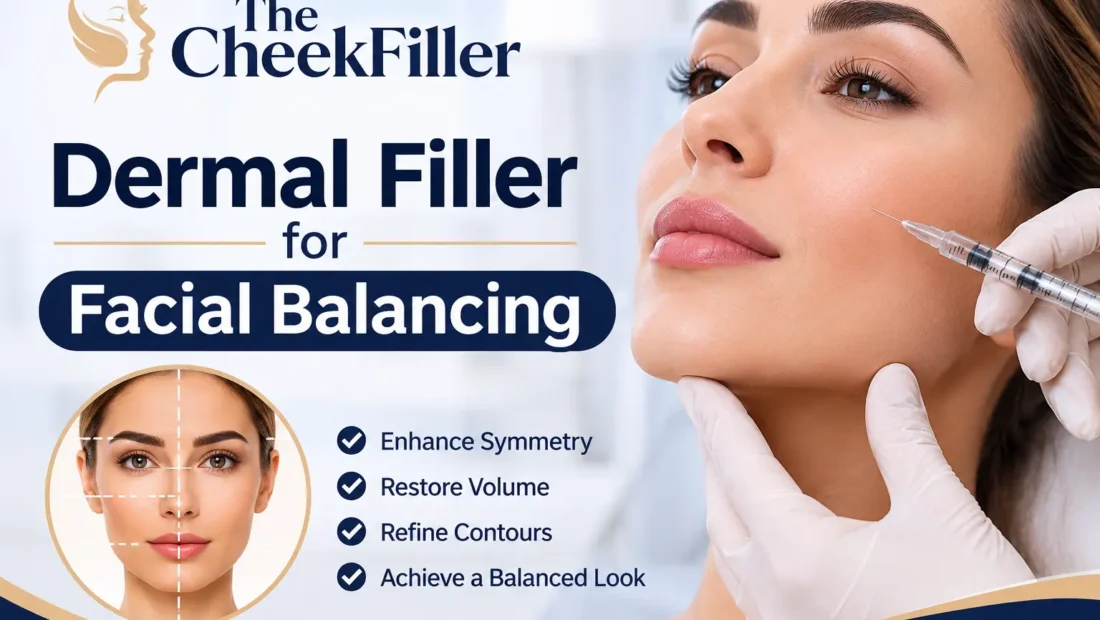
Facial balancing is a comprehensive, full-face approach to cosmetic injectables. Instead of focusing on a hyper-specific problem area, an experienced aesthetic provider steps back to evaluate your entire facial structure from multiple angles. The ultimate goal is to establish ideal proportion and symmetry, ensuring that your individual features look naturally cohesive and like they belong together.
Think of your face as a complex architectural structure. If the foundation is sagging, patching a crack in the drywall won’t fix the core issue. Many times, the area where a patient notices aging or asymmetry is actually a symptom of a structural deficit somewhere else. Facial balancing identifies these root causes, using strategically placed dermal fillers to provide structural support, restore lost volume, and create seamless transitions across the facial planes.
How Dermal Fillers Improve Facial Proportion and Symmetry
Humans are naturally drawn to facial symmetry and specific proportional ratios—often referred to in art and science as the “Golden Ratio.” While absolute, mathematical perfection doesn’t exist in nature (and would actually look quite unnatural), improving the harmony between the upper, middle, and lower thirds of the face drastically enhances overall attractiveness.
As we age, we experience bone remodeling, fat pad shifting, and a decline in collagen production. This causes the face to lose its foundational support, leading to drooping skin and harsh shadows. Dermal fillers act as a structural replacement. By carefully depositing filler deep onto the bone or within specific fat pads, an expert injector can manipulate how light reflects off your face. Restoring support to the midface, for example, can visibly lift the lower face, effortlessly softening a heavy jawline without ever injecting the jaw itself. It is this nuanced understanding of anatomy that allows dermal fillers to create profound, yet entirely natural-looking, improvements in facial proportion.
Best Areas to Treat for Facial Balance
A proper facial balancing plan is highly customized, but several key areas consistently play a major role in establishing structural harmony.
Cheeks and Midface
The cheeks dictate facial width, contour, and the crucial visual transition from the lower eyelid down to the lower face. Age-related bone changes reduce this midface support over time. Restoring volume here lifts adjacent tissues and softens the lower face. However, an expert touch is required; placing too much filler in the front of the cheek can cause the face to look heavy and inadvertently narrow the eyes when smiling.
Chin
The chin is the anchor of the lower face and is absolutely central to your side profile. A recessed, narrow, or asymmetric chin can negatively change how your nose, lips, jawline, and neck are perceived. Adding targeted projection to the chin brings the side profile into balance and dramatically improves how the jawline reads from the front.
Jawline
A crisp jawline creates a beautiful separation between the face and the neck. Jawline filler is excellent for improving definition or masking a pre-jowl indentation. However, it is not a replacement for a surgical facelift. Adding filler indiscriminately along the jawline can actually backfire, making the lower face look excessively wide or heavy.
Temples
Temple hollowing is an incredibly common sign of aging that patients rarely notice on themselves. When the temples lose volume, the upper face can take on a narrow, skeletal appearance. Carefully restoring volume to this complex area softens the transition into the brow and cheek, rejuvenating the entire upper third of the face.
Lips
Beautiful lips must remain in proportion to the chin, philtrum, and dental show. Natural-looking lip filler does not always mean a dramatic increase in size; sometimes, subtle hydration, shape refinement, or simply supporting the surrounding tissues is the key to perfect balance.
Which Dermal Fillers Are Used for Facial Balancing?
To achieve seamless facial harmony, injectors rely on different types of products depending on the depth of the injection and the specific goal of the treatment.
Hyaluronic Acid (HA) Fillers
Hyaluronic acid is a naturally occurring sugar substance already found in your skin. HA fillers (such as Juvederm, Restylane, and Revanesse) are the most common choice for facial balancing because they add immediate volume and structural support. They come in various thicknesses—stiffer gels are used to build cheekbones and jawlines, while softer, more flexible gels are used for the lips. A major advantage of HA fillers is that they are entirely reversible; they can be dissolved with an enzyme called hyaluronidase if your goals change or if a complication occurs.
Biostimulators
Unlike HA fillers that physically plump the skin immediately, biostimulators work by prompting your body’s natural immune response to generate its own new collagen and elastin. Products like Radiesse (calcium hydroxylapatite) and Sculptra (poly-L-lactic acid) fall into this category. While some offer a degree of instant volume, the true results develop gradually over several weeks and months as your tissue regenerates. Biostimulators are incredible for improving overall skin quality, tone, and long-term structural firmness.
Facial Balancing vs Liquid Facelift vs Treating One Area
Understanding the terminology in the aesthetic world can be confusing. Here is how facial balancing differs from other common approaches:
- Treating One Area: This is the traditional, reactionary approach. You point out a flaw (like a nasal bridge bump or thin lips), and the injector treats only that specific spot. While cheaper upfront, this often fails to address the root cause of aging and can lead to an unnatural, “done” look over time.
- Liquid Facelift: This approach specifically targets signs of aging. The primary goal of a liquid facelift is to restore lost volume, lift sagging tissues, and reduce wrinkles in mature skin, mimicking the lifting effects of a surgical facelift without the scalpel.
- Facial Balancing: This is purely about proportion, harmony, and optimization. It is age-agnostic. A 25-year-old might seek facial balancing to build a stronger chin and jawline that they weren’t born with, while a 55-year-old might use it to restore lost midface support. The goal is geometric harmony, not just anti-aging.
Who Is a Good Candidate for Facial Balancing?
Because this approach is highly customized, it is suitable for a wide variety of people. You are likely a great candidate for facial balancing if you align with any of the following:
- You feel your facial features don’t quite “fit” together, but you can’t pinpoint exactly why.
- You have experienced midface volume loss that is causing heaviness in your lower face or jowls.
- You want to improve your side profile, particularly the relationship between your nose, lips, and chin.
- You have a naturally weak or recessed chin and desire better jawline definition.
- You are looking for subtle, holistic enhancements rather than looking like you have obvious “work done.”
What Happens During a Facial Balancing Appointment
A facial balancing appointment is highly collaborative. It begins with an in-depth consultation. Your provider will not just look at you straight-on; they will assess your face from multiple angles, paying close attention to your profile, where structural support has diminished, and how your features flow into one another.
Once a treatment plan is established, your injector will map out the precise injection points. Your skin will be thoroughly cleansed, and a topical numbing cream is usually applied to ensure your comfort. Most modern fillers also contain lidocaine, meaning the area numbs further as the product is placed. The actual injection process involves a mix of fine needles and blunt-tipped micro-cannulas to safely deposit the product at various depths. Following the procedure, you will receive aftercare instructions and can typically return to your normal daily activities, though some minor swelling is to be expected.
How Long Do Facial Balancing Results Last?
The longevity of your results depends heavily on the type of product used, the area treated, and your own body’s metabolism. In general, hyaluronic acid filler results last anywhere from 8 to 18 months.
Areas of the face with high movement—like the lips or around the mouth—tend to metabolize filler much faster than structural areas like the cheeks, chin, and jawline. Biostimulators, because they rely on your body’s own newly generated collagen, offer a longer-lasting outcome, with results extending up to two years. It is important to remember that most approved fillers are temporary, and maintaining optimal facial harmony usually requires a touch-up appointment once a year.
How Much Does Facial Balancing With Fillers Cost?
Because facial balancing looks at the whole face, it often requires more product than a single-area treatment. The average fee for a hyaluronic acid filler syringe across the U.S. is roughly $715. Depending on the specific product and the clinic, dermal fillers generally cost between $199 and $800 per syringe.
Most clients require one to two syringes per session, though a comprehensive balancing plan addressing multiple areas could require three or more. Reputable injectors will always start conservatively and build toward your goal over time so you never pay for more product than you truly need.
Here is a general breakdown of what to expect when building a facial balancing budget:
| Treatment Area | Typical Syringes Needed | Estimated Price Range |
| Lips | 0.5 to 1 syringe | $199 – $800 |
| Cheeks & Midface | 1 to 3 syringes | $400 – $2,400 |
| Chin Projection | 1 to 2 syringes | $400 – $1,600 |
| Jawline Definition | 2 to 4 syringes | $800 – $3,200 |
| Temples | 1 to 2 syringes | $400 – $1,600 |
Note: Pricing fluctuates wildly based on your geographic location, the expertise of your provider, and the specific brand of filler used. Always ask for a tailored quote during your consultation.
Risks, Side Effects and Signs of Overfilling
As with any medical procedure, dermal fillers carry inherent risks. Common side effects include temporary swelling, bruising, redness, and mild tenderness at the injection sites. These typically resolve within a few days to two weeks. A rare but serious medical risk is vascular occlusion, which occurs if filler is accidentally injected into a blood vessel, impeding blood flow. This is why choosing a highly trained, licensed medical provider is non-negotiable.
Aesthetically, the biggest risk is overfilling. When a provider lacks an understanding of facial harmony, adding too much product can lead to the dreaded “pillow face.” Excessive cheek filler can crowd the eyes, while too much jawline filler can masculinize a feminine face or make the lower face appear bottom-heavy. A true expert knows that sometimes, the best decision is knowing when not to inject.
Final Thoughts: Is Facial Balancing Right for You?
True aesthetic enhancement should never look like a filter; it should look like the most rested, confident, and harmonious version of yourself. Facial balancing moves away from the outdated “spot treatment” mentality and respects the intricate structural relationships of your anatomy. Whether you are looking to rewind the clock on midface volume loss or you want to build the striking side profile you’ve always dreamed of, a holistic approach is the key to undetectable, sophisticated results.
Written and reviewed by the content team at The CheekFiller | Last updated October 2026
AI tools assisted with the initial draft. Our team reviewed and edited the content for clarity, accuracy, and reader usefulness.
Considering treatment?
Browse injectors in our directory and compare their training, treatments and location before you book a consultation.