
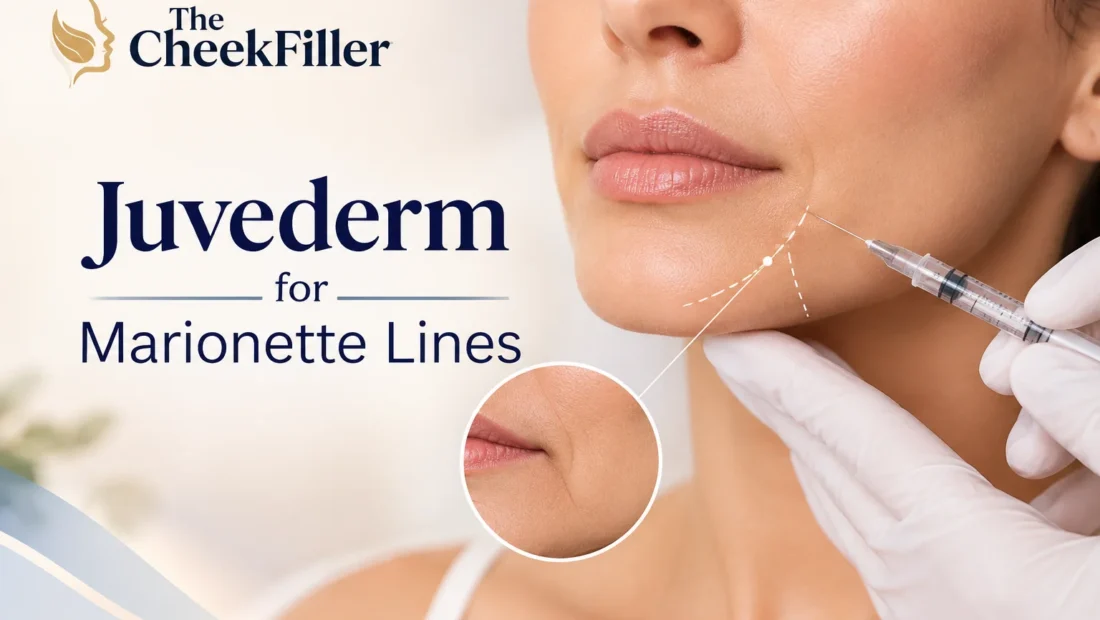
If you’ve noticed two faint creases running from the corners of your mouth down toward your chin, you’re not imagining things and you’re definitely not alone. Those grooves are called marionette lines, and they’re one of the most common concerns clients bring up during consultations. The good news? Juvederm has become one of the most trusted, predictable ways to soften them without surgery, needles-and-thread lifts, or weeks of downtime.
In this guide, we’ll walk through exactly what marionette lines are, why Juvederm works so well for them, which formula tends to get chosen for this area, what the treatment actually feels like, and how to get results that look like you, just rested and refreshed, not “done.”
What Are Marionette Lines, Exactly?
Marionette lines get their name from the resemblance to the hinged mouth of a wooden puppet. They run vertically from the corners of the mouth down to the jawline, and as they deepen, they can pull the lower face into a tired or downturned expression, even when you’re not frowning at all.
Unlike fine surface wrinkles, marionette lines are largely a volume loss problem, not just a skin-texture problem. That distinction matters, because it’s exactly why a dermal filler like Juvederm tends to outperform creams, lasers, or topical retinoids for this particular concern.
Why Do Marionette Lines Form?
A few overlapping factors drive their development:
- Collagen and elastin decline: starting in your late 20s and accelerating after 40, the skin’s structural support thins out.
- Fat pad descent: the cheek fat pads that once plumped the mid-face gradually shift downward, dragging tissue along the nasolabial fold and marionette line with them.
- Bone remodeling: the jawbone and maxilla lose density over time, removing the underlying scaffolding the skin used to rest on.
- Repeated muscle movement: talking, chewing, and expressive habits (like a downturned resting mouth shape) can deepen the crease over years.
- Genetics and sun exposure: some people are simply predisposed to earlier or more pronounced marionette lines, and UV damage speeds the process along.
Because so much of this is volume-related rather than purely a wrinkle on the surface, Botox alone typically won’t resolve marionette lines, there isn’t much muscle activity causing them the way there is with crow’s feet or forehead lines. This is where hyaluronic acid fillers earn their reputation as the go-to solution.
Why Juvederm Works So Well for Marionette Lines
Juvederm is a family of hyaluronic acid (HA) dermal fillers developed by Allergan Aesthetics, and it’s built around a technology called Vycross, which cross-links HA molecules to create gels with different consistencies from soft and flexible to firm and structural. That range is exactly why Juvederm is so versatile for the lower face.
Hyaluronic acid is a substance your body already produces naturally; it holds up to 1,000 times its weight in water and gives skin its plumpness and bounce. When injected into the marionette line area, Juvederm:
- Restores lost volume beneath the crease, lifting the tissue that has descended
- Smooths the visible groove from the corner of the mouth to the jawline
- Attracts and retains water, giving the area a hydrated, supple look
- Gradually breaks down and metabolizes, so results are never permanent, a safety feature many clients actually appreciate
Which Juvederm Formula Is Used for Marionette Lines?
Not every Juvederm product is suited to this area. The formula chosen depends on how deep the lines are, how much volume loss is present, and the skin’s thickness in that region.
| Juvederm Formula | Consistency | Best Use for Marionette Lines | Typical Longevity |
| Juvederm Voluma XC | Firm, structural gel | Restoring deep volume loss and lifting the lower cheek/jawline area that feeds into the marionette line | Up to 18–24 months |
| Juvederm Vollure XC | Medium-firm, flexible | Directly softening moderate-to-severe marionette lines and nasolabial folds | Up to 18 months |
| Juvederm Volbella XC | Soft, fine gel | Superficial, finer lines and very subtle corrections near the mouth | Up to 12 months |
| Juvederm Ultra Plus XC | Medium-firm | An alternative option for moderate marionette lines requiring more support than a soft filler | Up to 12 months |
In many cases, injectors at The Cheek Filler will layer more than one formula — for instance, using Voluma to rebuild cheek and jawline support, then Vollure to refine the marionette line itself. This layered technique, sometimes called a “liquid lift,” tends to produce more natural, longer-lasting results than treating the line in isolation.
Vollure vs. Voluma: Which One Do You Actually Need?
This is one of the most common questions we hear, so here’s the simple version:
- If your marionette lines are the main concern and your cheeks still have reasonable volume → Vollure is often the more direct choice.
- If your cheeks have flattened or your mid-face has visibly dropped, contributing to the marionette lines → Voluma addresses the root cause first, which can soften the marionette lines indirectly by lifting the tissue above them.
An experienced injector will assess your facial anatomy, not just the line itself, before recommending a formula. This is why a proper in-person consultation matters more than trying to self-diagnose from a photo.
What to Expect During Treatment
Understanding the process ahead of time tends to ease most people’s nerves. Here’s a realistic walkthrough of a typical Juvederm session for marionette lines.
Before the Appointment
You’ll usually be asked to avoid blood-thinning substances — aspirin, ibuprofen, fish oil, vitamin E, and alcohol — for about 24 to 48 hours beforehand. This isn’t strictly required, but it meaningfully reduces the chance of bruising.
During the Procedure
- Consultation and mapping – your injector examines your facial structure, discusses your goals, and marks injection points.
- Numbing – most Juvederm formulas already contain lidocaine, and a topical numbing cream is often applied beforehand too, so discomfort is minimal.
- Injection – using a fine needle or cannula, the filler is placed in small, controlled amounts along the marionette line and, if needed, into the surrounding cheek or jawline.
- Massage and assessment – the treated area is gently massaged to smooth the product and check symmetry.
The entire appointment typically takes 20 to 30 minutes.
After Treatment: Recovery and Aftercare
Most people return to normal activities the same day. That said, a few things are worth knowing:
- Mild swelling, redness, or bruising at injection sites is common and usually resolves within a few days to a week.
- Ice packs (wrapped, not applied directly to skin) can help manage swelling in the first 24 hours.
- Avoid intense exercise, alcohol, and excessive sun or heat exposure for about 48 hours.
- Sleeping slightly elevated the first night or two can reduce puffiness.
- Final results settle in over roughly two weeks, once any residual swelling resolves.
How Long Does Juvederm Last in the Marionette Line Area?
Longevity varies by formula and by individual metabolism, but here’s a general guide:
- Voluma XC: up to 18–24 months
- Vollure XC: up to 18 months
- Volbella XC: up to 12 months
- Ultra Plus XC: up to 12 months
Factors like a faster metabolism, high activity levels, and even the amount of facial movement in that area can cause the filler to metabolize somewhat faster. Most clients at The Cheek Filler schedule a touch-up appointment somewhere between the 9- and 15-month mark to maintain consistent results, rather than waiting until the filler has fully dissolved.
Juvederm vs. Other Options for Marionette Lines
It’s worth understanding how Juvederm compares to alternatives, since not every treatment is a fit for every person.
Juvederm vs. Restylane
Both are hyaluronic acid fillers, and both are well-established, FDA-approved options. The main difference lies in the gel technology — Juvederm’s Vycross formulas tend to be smoother and more cohesive, which many injectors find gives a subtler, more blendable result for delicate areas like marionette lines. Restylane’s XpresHAn technology, on the other hand, is designed to flex more with facial expression. Either can work well; the right choice often comes down to your injector’s clinical judgment and your specific facial anatomy.
Juvederm vs. Botox
Botox relaxes muscle activity, which is excellent for dynamic wrinkles like forehead lines or crow’s feet. Marionette lines, however, are driven primarily by volume loss and gravity rather than muscle contraction, so Botox alone generally won’t soften them. Some injectors do use a small amount of Botox on the surrounding depressor muscles (the DAOs) to prevent further downward pull, but this is typically a complement to filler, not a replacement for it.
Juvederm vs. Thread Lifts or Surgical Options
Thread lifts and lower facelifts can address more advanced sagging, but they come with more downtime, higher cost, and more risk. For the large majority of people with mild to moderate marionette lines, Juvederm delivers comparable visual improvement with a fraction of the recovery time, which is exactly why it remains the first-line treatment recommended at The Cheek Filler for this concern.
Are You a Good Candidate for Juvederm Marionette Line Treatment?
Juvederm tends to work especially well for people who:
- Are noticing early-to-moderate creases from the mouth corners to the jawline
- Have some volume loss in the cheeks or lower face contributing to the lines
- Want a non-surgical option with little to no downtime
- Are looking for results that last months, not weeks, without a permanent commitment
It may not be the right fit for people with active skin infections near the treatment area, certain autoimmune conditions, or a history of severe allergic reactions to hyaluronic acid products. This is exactly the kind of detail a proper consultation is designed to catch which is why The Cheek Filler always starts with a thorough health and goals conversation before any injection is planned.
Potential Side Effects and Safety Considerations
Juvederm has a strong safety track record, but like any injectable, it isn’t risk-free. Common, expected side effects include:
- Temporary swelling, redness, or tenderness
- Mild bruising
- Small bumps under the skin that typically smooth out within days
Rare but more serious risks include infection, filler migration, or vascular occlusion (when filler is accidentally injected into or compresses a blood vessel). This is precisely why injector experience matters so much, the lower face has a dense network of vessels, and precise, anatomy-aware technique is the single biggest factor separating a smooth outcome from a complication. Choosing a credentialed, experienced provider isn’t a “nice to have” here; it’s the most important decision in the entire process.
Final Thoughts
Marionette lines are a natural part of facial aging, but they don’t have to define how tired or stern your face looks in the mirror. Juvederm offers a well-studied, predictable way to restore lost volume, soften the crease, and bring back a more rested, balanced lower-face contour — all without surgery or significant downtime.
If you’re considering treatment, the most important step isn’t choosing between Voluma, Vollure, or Volbella on your own — it’s finding an injector who can assess your unique facial anatomy and build a plan around it. That personalized, anatomy-first approach is exactly what guides every consultation at The Cheek Filler, where the goal is always a result that looks like a refreshed version of you, not a visibly “filled” one.
Considering treatment?
Browse injectors in our directory and compare their training, treatments and location before you book a consultation.