
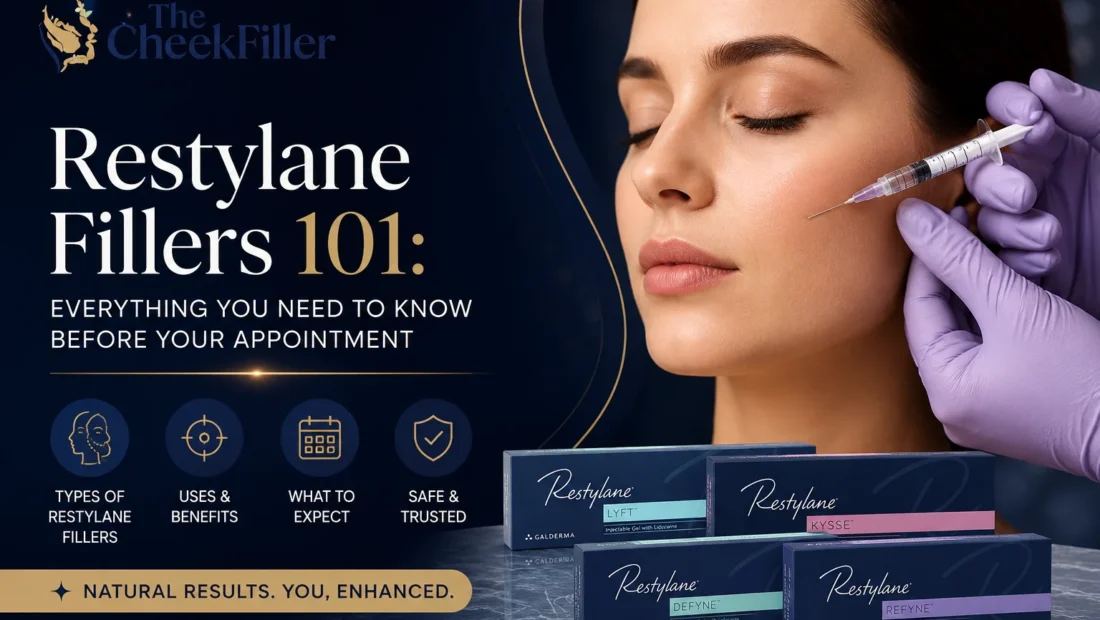
If you’ve spent any time researching dermal fillers, you’ve probably run into the name Restylane more than once. It’s one of the oldest and most trusted names in the injectable world, and honestly, that’s not by accident. Restylane has been around since the late 1990s, which in the world of aesthetics is basically ancient history, and it’s still one of the go-to choices for injectors today.
But here’s the thing: “Restylane” isn’t just one product. It’s an entire family of fillers, each formulated for a different job. Some are built for plumping lips, others for sculpting cheekbones, and a few are so fine and gentle they’re made for the delicate skin under your eyes. Walking into a consultation without understanding this can leave you feeling a little lost, so let’s break it all down in plain English.
Ask AI About This Page
What Is Restylane, Exactly?
Restylane is a line of hyaluronic acid (HA) dermal fillers manufactured by Galderma. Hyaluronic acid is a substance your body already produces naturally; it’s what keeps your skin plump, hydrated, and bouncy when you’re younger. As we age, HA production slows down, which is part of why skin starts to look thinner and less resilient over time.
Restylane fillers use lab-created HA to temporarily restore that lost volume. The gel is injected into targeted areas of the face (or hands), where it adds structure, smooths lines, and restores a fuller, more youthful contour. Because HA is biocompatible, your body gradually breaks it down over months, which is why these treatments aren’t permanent – a feature most patients actually appreciate, since it means less commitment and more room to adjust as your preferences change.
Why Injectors Reach for Restylane So Often
- It has a long track record, with decades of clinical use and safety data
- The formulations are diverse enough to treat almost any facial area
- Results are reversible with hyaluronidase if something needs correcting
- It integrates naturally into the skin rather than sitting rigidly under it
The Restylane Family: Not All Fillers Are Created Equal
This is where a lot of confusion sets in. People hear “I’m getting Restylane” and assume it’s a single product, but the brand actually manufactures several distinct formulas, each engineered with a different HA concentration, particle size, and gel technology. That’s what determines whether a filler is better suited for fine lip lines or for lifting the mid-cheek.
Here’s a quick side-by-side so you can see how the lineup breaks down.
| Product | Best For | Typical Longevity |
| Restylane Refyne | Smoothing moderate nasolabial folds and marionette lines | 9–12 months |
| Restylane Defyne | Deeper laugh lines and folds needing more support | 9–12 months |
| Restylane Lyft | Cheek volume, midface contouring, hand rejuvenation | 12–18 months |
| Restylane Silk | Fine lip lines and subtle lip enhancement | 6–10 months |
| Restylane Kysse | Natural-looking lip volume with flexibility | 10–12 months |
| Restylane Contour | Cheek definition and structural lift | 12+ months |
| Restylane Eyelight | Under-eye hollows and tear trough correction | 9–12 months |
Keep in mind, these timelines vary from person to person. Your metabolism, activity level, and even where the filler is placed all play a role in how long it lasts.

Breaking Down the Key Players
Restylane Lyft tends to come up a lot in cheek augmentation conversations. It uses a larger particle size, which gives it the lift and structure needed to rebuild volume in areas like the cheekbones, where you need the filler to hold its shape rather than just fill space.
Restylane Kysse was actually developed specifically with lips in mind; the name is a nod to that. It uses XpresHAn Technology, which allows the gel to flex and move naturally with your facial expressions instead of feeling stiff when you smile or talk.
Restylane Contour is one of the newer additions and has become popular for people wanting more defined, sculpted cheeks without an artificial or “overfilled” look.
Restylane Eyelight is designed for one of the trickiest areas to treat, the under-eye. This skin is thin and sensitive, so the formula is lighter and smoother than fillers meant for cheeks or lips.
What Actually Happens During a Restylane Treatment
If this is your first time considering filler, the process is more straightforward than most people expect.
- Consultation: Your injector assesses your facial structure, skin quality, and goals, then recommends which product (or combination) fits best.
- Numbing: Most Restylane formulas already contain lidocaine, so discomfort is minimal, but topical numbing cream is often applied beforehand anyway.
- Injection: Using a fine needle or cannula, the filler is placed at a precise depth depending on the treatment area.
- Assessment: Your provider will check symmetry and may add small amounts to fine-tune the result.
- Aftercare instructions: You’ll be told what to avoid for the next 24–48 hours (more on that below).
The whole appointment typically takes 30 to 45 minutes, and there’s little to no downtime, which is part of what makes filler so appealing for people with busy schedules.
What You Might Feel Afterward
- Mild swelling or puffiness, especially in the lips
- Slight bruising at injection points
- Tenderness when touched
- Occasional firmness that softens over the first week or two
None of this should alarm you it’s a normal part of your body adjusting to the product. Most swelling settles within a few days, though full results usually show once everything has fully integrated, generally around the two-week mark.
Is Restylane Right for You?
Good candidates for Restylane are generally people who:
- Are noticing early to moderate volume loss or fine lines
- Want a natural-looking result rather than a dramatic transformation
- Prefer a treatment that isn’t permanent
- Don’t have active skin infections or certain autoimmune conditions in the treatment area
That said, this isn’t a one-size-fits-all decision. Pregnant or breastfeeding individuals, and those with a history of severe allergic reactions to HA products, are typically advised to hold off. A qualified injector will walk through your medical history before recommending any treatment plan.
A Quick Note on Choosing Your Injector
The product matters, but who’s holding the needle matters just as much arguably more. Restylane in the hands of an experienced, board-certified injector and Restylane in inexperienced hands can produce very different results, even though it’s technically the same filler. When researching providers, look for:
- Board certification in dermatology, plastic surgery, or a related field
- Before-and-after photos of real patients
- A consultation process that discusses risks, not just benefits
- Clear communication about which specific product they’re recommending and why
Restylane vs. Other HA Fillers: How Does It Compare?
You’ve probably also heard of Juvederm, another major HA filler brand. Both use hyaluronic acid, but they rely on different gel technologies, Restylane uses NASHA and XpresHAn technology, while Juvederm uses Vycross and Hylacross formulations. In practice, this means the two brands can feel and behave slightly differently once injected, with some injectors preferring Restylane for its flexibility in delicate areas and others favoring Juvederm for smoother, more spreadable results in larger volume areas.
Neither brand is objectively “better” across the board it really comes down to the specific product, the treatment area, and your injector’s clinical judgment.
Aftercare: Making Your Results Last
Taking care of your skin post-treatment isn’t complicated, but a few habits genuinely make a difference:
- Avoid strenuous exercise for 24 hours to reduce swelling and bruising
- Skip alcohol the day of treatment, since it can thin the blood
- Stay away from extreme heat (saunas, hot yoga) for a couple of days
- Use a cold compress if swelling feels uncomfortable
- Be gentle with the treated area no aggressive massaging unless your injector specifically instructs it
Staying hydrated also helps, since HA fillers are drawn to water in the skin. Well-hydrated skin tends to show off filler results more smoothly.
The Bottom Line
Restylane isn’t a single product; it’s a toolkit. Understanding the differences between Lyft, Kysse, Contour, Eyelight, and the rest means you can walk into your consultation with realistic expectations and better questions to ask. The right formula, paired with a skilled injector, is what turns a filler appointment into a result that looks like you, just refreshed.
If you’re on the fence about which Restylane product fits your goals, that’s exactly what a consultation is for – no two faces (or filler plans) are quite the same.
At The Cheek Filler, we believe getting filler shouldn’t feel confusing or intimidating. We break down the science, the options, and the honest pros and cons, so you can walk into any consultation feeling informed, not overwhelmed.
Considering treatment?
Browse injectors in our directory and compare their training, treatments and location before you book a consultation.