If you’ve ever sat in a consultation chair and heard your injector mention “Juvederm” or “Restylane,” you’ve probably wondered who actually makes this stuff? It’s a fair question. Dermal fillers aren’t some mystery gel cooked up in a back room. They’re pharmaceutical-grade products developed by a small handful of companies that have spent decades and, in some cases, billions of dollars perfecting hyaluronic acid formulas, running clinical trials, and earning FDA approval.
Knowing who’s behind your filler matters more than most people realize. It tells you a lot about safety testing, longevity, and why your results might feel different from a friend’s, even if you both got “the same treatment.” So let’s walk through the five companies actually shaping the industry, what they make, and why it’s worth knowing their names before your next appointment.
Why It Matters Who Manufactures Your Filler
Before we get into the list, it’s worth answering the “so what” question. Dermal fillers are medical-grade injectables, which means the manufacturer behind the syringe is directly responsible for:
- Clinical safety data: How the product performed in FDA trials before it ever reached a patient
- Formulation quality: The cross-linking technology that determines how smooth, firm, or long-lasting a filler feels
- Consistency batch to batch: A real concern with unregulated, non-FDA-approved products sold online
- Reversibility and complication management: established brands have documented protocols if something needs to be dissolved or adjusted
This is part of why reputable clinics, ours included, only inject FDA-approved fillers from manufacturers with a real regulatory track record. It’s not a minor detail, it’s the foundation of a safe result.

The Top 5 Dermal Filler Manufacturing Companies
1. Allergan Aesthetics (an AbbVie Company) – Maker of Juvederm
Allergan Aesthetics is arguably the name most people already know, even if they don’t realize it. Originally an independent aesthetics powerhouse, Allergan was acquired by AbbVie in 2020, and the combined company now controls a massive share of the global filler market.
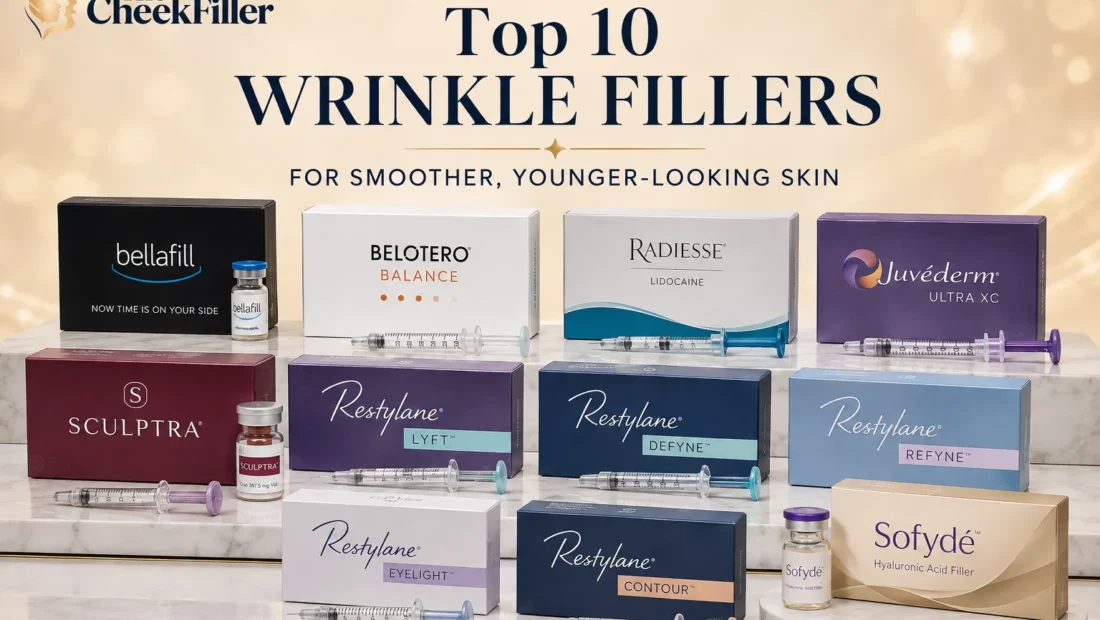
Their flagship line, Juvederm, includes several targeted formulas rather than a one-size-fits-all product:
- Juvederm Voluma XC – built for cheek volume and midface lift
- Juvederm Vollure XC – softer, ideal for smile lines
- Juvederm Volbella XC – fine lines and subtle lip enhancement
- Juvederm Ultra XC/Ultra Plus XC – classic lip and moderate wrinkle correction
What sets Allergan apart is its proprietary Vycross and Hylacross cross-linking technologies, which control how the hyaluronic acid gel behaves once injected, smoother spread, longer duration, and a more natural feel under the skin. Juvederm Voluma, for example, is one of the most extensively studied fillers for midface volumization, which is exactly why it’s a go-to choice for cheek augmentation.
2. Galderma – Maker of Restylane and Sculptra
Galderma is a Swiss dermatology company that’s been a serious player in aesthetics for over 25 years, and its portfolio is arguably the most diverse on this list. It doesn’t just make hyaluronic acid fillers, it covers multiple filler categories entirely.
Notable products include:
- Restylane, Restylane Lyft, and Restylane Kysse – HA fillers using Galderma’s NASHA and XpresHAn technologies for a range of textures, from firm structural support to soft, flexible movement in the lips
- Sculptra – a poly-L-lactic acid (PLLA) biostimulator that gradually rebuilds collagen rather than adding instant volume
- Restylane Defyne and Refyne – designed specifically for dynamic areas like the nasolabial folds, where the face needs to keep moving naturally
Galderma’s edge is its research into how fillers behave with facial expression, not just at rest. Restylane Lyft, for instance, was one of the first fillers to gain FDA approval specifically for cheek augmentation, which is a big part of why it remains a mainstay in midface treatment plans.
Compare Juvederm vs Restylane.
3. Merz Pharmaceuticals – Maker of Radiesse and Belotero
Merz is a German, family-owned pharmaceutical company with a much longer history than most people assume, it’s been in operation for over a century. In aesthetics, it’s best known for taking a different chemical approach than pure hyaluronic acid.
- Radiesse is a calcium hydroxylapatite (CaHA) filler suspended in a gel carrier. It provides immediate volume, but the real value is what happens over the following months: the CaHA microspheres stimulate the body’s own collagen production, so results can improve well after the initial injection.
- Belotero Balance is a finely cross-linked HA filler designed for superficial lines and delicate areas like under-eye hollows, where a thicker gel would look lumpy or unnatural.
Merz has carved out a niche among providers who want a biostimulatory option alongside traditional HA fillers, especially for patients focused on skin quality and gradual collagen rebuilding rather than just volume.
4. Teoxane Laboratories – Maker of the RHA Collection
Teoxane is a Swiss biotech company that took a genuinely different approach to hyaluronic acid manufacturing, and it’s paid off. Its RHA (Resilient Hyaluronic Acid) Collection, RHA 2, RHA 3, RHA 4, and RHA Redensity, uses a gentler cross-linking process designed to preserve the HA’s natural molecular structure.
Why does that matter? Traditional cross-linking can make gels feel a bit stiff. Teoxane’s approach aims to keep the filler moving the way skin naturally does, which is why RHA products are frequently chosen for areas with a lot of movement, like the lips and lower face. RHA Redensity also became the first FDA-approved filler specifically indicated for moderate to severe lip lines, a fairly narrow but clinically meaningful distinction.
5. Revance Therapeutics / Prollenium – Makers of RHA-Adjacent and Versa Lines
Rounding out the top five, this space is shared by a couple of fast-growing manufacturers worth knowing. Revance Therapeutics, a U.S. company, has expanded aggressively in aesthetics (it’s also behind the neuromodulator Daxxify) and continues investing in next-generation HA formulations. Prollenium Medical Technologies, a Canadian manufacturer, produces the Revanesse Versa line – a lidocaine-infused HA filler line that’s gained traction for its smooth injection experience and competitive pricing without cutting corners on FDA approval.
Both companies represent where the industry is heading: more manufacturers entering the HA space, more competition on formulation science, and more options for injectors to match a filler precisely to a patient’s anatomy and goals.
Comparing the Top 5 Filler Manufacturers at a Glance
| Company | Flagship Products | Filler Type | Best Known For |
| Allergan Aesthetics (AbbVie) | Juvederm Voluma, Vollure, Volbella | Hyaluronic acid | Cheek and midface volumization |
| Galderma | Restylane, Restylane Lyft, Sculptra | HA and PLLA | Broadest portfolio, dynamic-area fillers |
| Merz Pharmaceuticals | Radiesse, Belotero | CaHA and HA | Collagen stimulation, fine-line correction |
| Teoxane Laboratories | RHA 2/3/4, RHA Redensity | Hyaluronic acid | Natural movement, lip lines |
| Revance / Prollenium | Revanesse Versa, next-gen HA | Hyaluronic acid | Smooth injection, growing innovation |
How Injectors Choose Which Manufacturer to Use
If you’ve noticed that different clinics favor different brands, that’s not random. Injectors typically choose a filler based on:
- The treatment area: a firm, structural filler like Juvederm Voluma or Restylane Lyft works well for cheekbones, while a softer gel like Belotero suits under-eye hollows.
- Desired longevity: HA fillers generally last 6–18 months depending on the formula, while Sculptra’s collagen-building effects can last two years or more.
- Patient anatomy and skin quality: thinner skin often calls for a softer, more flexible gel to avoid visible lumps or the Tyndall effect.
- Reversibility: HA fillers can be dissolved with hyaluronidase if needed, which is one reason they remain the most commonly used category overall.
A skilled injector isn’t loyal to one brand for the sake of it, they’re matching the manufacturer’s specific formulation science to what your face actually needs.
The Takeaway
At the end of the day, the “best” filler manufacturer isn’t a single winner, it’s whichever company makes the product that fits your face, your goals, and your injector’s expertise. What matters most is working with a provider who uses FDA-approved products from established manufacturers like the ones above, rather than unregulated fillers with no real safety track record.
At The Cheek Filler, we use premium, FDA-approved formulations – including Juvederm Voluma and Restylane Lyft – because we’ve seen firsthand how much manufacturer quality affects both safety and results. If you’re ready to talk through which filler makes sense for you, book a consultation and we’ll walk you through your options honestly, brand names and all.
Considering treatment?
Browse injectors in our directory and compare their training, treatments and location before you book a consultation.