
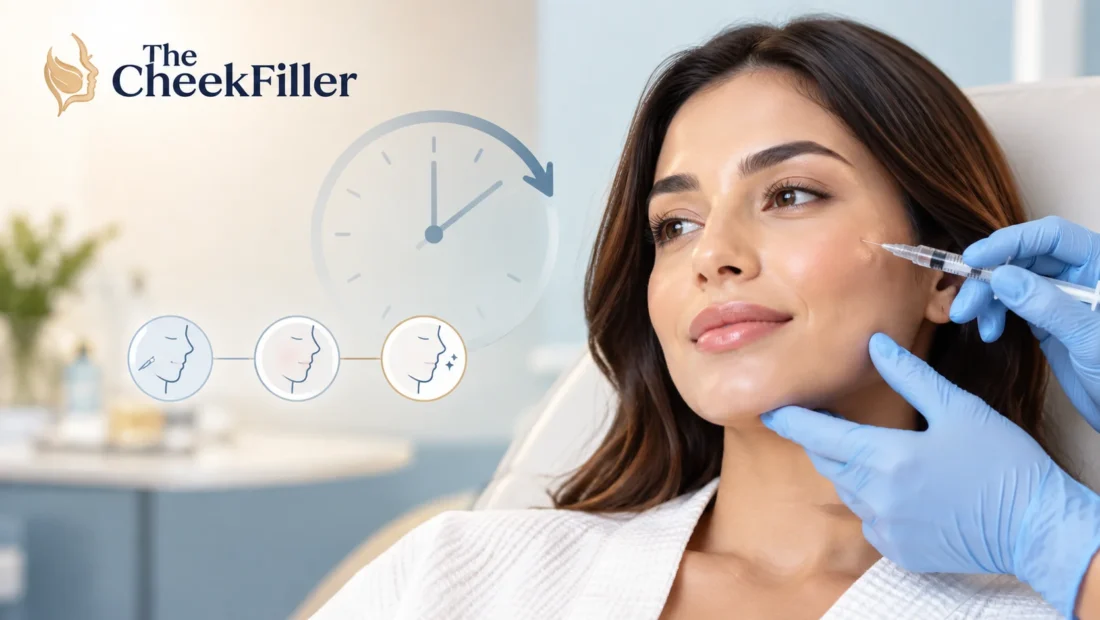
So you finally booked your cheek filler appointment, walked out of the clinic feeling excited (and maybe a little swollen), and now you’re standing in front of the mirror wondering: does this look right? If you’re Googling “how long does cheek filler take to settle” at 11 p.m. while poking your cheekbone, you’re in good company. This is one of the most common questions injectors hear, and honestly, it’s a fair one, dermal fillers don’t look like their final version the moment you leave the treatment room.
Let’s walk through exactly what’s happening under your skin, how long the process really takes, and what you can do to help things along. At The Cheek Filler, we get this question from nearly every client, so we’ve put together this guide based on what we see in the treatment room every day.
Why Cheek Filler Doesn’t Look Final Right Away
Immediately after injection, your cheeks aren’t showing you the “real” result. What you’re seeing is a mix of the actual filler placement plus swelling, minor bruising, tissue trauma, and fluid retention. Hyaluronic acid (HA) fillers also attract water, so there’s often a temporary “puffy” phase before the product integrates with your natural tissue.
Think of it like a sculptor’s first rough pass. The shape is there, but the fine detail and smoothness haven’t emerged yet. That happens gradually as inflammation subsides and the filler settles into its intended position.
The Injection Trauma Factor
Needles or cannulas create tiny micro-injuries as they pass through tissue. Your body responds the way it responds to any injury, inflammation, localized swelling, and sometimes small bruises. This is a completely normal part of the healing process, not a sign that something went wrong.
The General Cheek Filler Settling Timeline
Most patients can expect a full settling period of two to four weeks, though the visible improvement happens in stages rather than all at once. Here’s a general breakdown of what to expect.
| Time After Treatment | What’s Typically Happening | What You Might Notice |
| Day 1–3 | Peak swelling and possible bruising | Cheeks may look overfilled, asymmetric, or puffy |
| Day 4–7 | Swelling begins to reduce | More natural contour starts appearing |
| Week 2 | Most visible swelling resolves | Shape looks close to final in most cases |
| Week 3–4 | Filler fully integrates with tissue | Final texture, symmetry, and softness settle in |
| Week 4+ | Complete settling | Result you’ll live with until it starts to metabolize |
Keep in mind, this table reflects average healing patterns – your personal timeline can shift depending on the factors we’ll cover below.
Factors That Affect How Quickly Filler Settles
No two faces (or injectors) are identical, so it makes sense that settling time varies from person to person.
Type of Filler Used
Different HA fillers have different consistencies, or “rheology.” Thicker, more cohesive fillers (often used for structural cheek volumizing) may take slightly longer to soften and blend compared to lighter, more fluid formulas used for subtle contouring.
Injection Technique
Cannula-based injections tend to cause less trauma and bruising than sharp needle injections, which can sometimes mean a shorter visible-swelling phase. That said, both techniques are widely used and considered safe and effective, it comes down to the injector’s judgment for your specific anatomy.
Amount of Filler Placed
Larger volumes naturally take longer to fully settle than a conservative, subtle enhancement. If you’re getting significant cheek augmentation in one session, expect the settling window to lean toward the longer end (three to four weeks).
Your Individual Healing Response
Skin thickness, circulation, hydration levels, age, and even genetics all influence how your body processes inflammation. Some people see their “final face” in ten days; others need the full month.
Aftercare Habits
Yes, what you do after your appointment genuinely matters – more on that below.
What’s Normal vs. What’s Not
It’s easy to spiral into worry during the first week, so here’s a quick gut-check.
Normal Post-Filler Signs
- Mild to moderate swelling for several days
- Slight asymmetry that improves over 1–2 weeks
- Tenderness or firmness at injection sites
- Small bruises that fade within a week or two
- A “tight” or “overfilled” sensation early on
Signs You Should Contact Your Provider
- Increasing pain, redness, or warmth after day 3–4 (rather than improving)
- Skin discoloration that looks dusky, mottled, or blistered
- Vision changes
- Significant asymmetry that hasn’t improved by the three-to-four-week mark
Most concerning complications, like vascular occlusion, tend to show up quickly rather than developing gradually, which is why it’s worth knowing the difference between “still settling” and “something’s wrong.”
Tips to Help Cheek Filler Settle Faster and Smoother
While you can’t rush biology entirely, a few habits genuinely support a smoother, faster healing process.
1. Manage Swelling Early
Gentle cold compresses in the first 24–48 hours can help reduce puffiness. Avoid pressing hard on the treated area, light and brief is the rule.
2. Skip Intense Exercise for a Few Days
Vigorous workouts increase blood flow and can worsen swelling or bruising. Most injectors recommend holding off on high-intensity exercise for around 48–72 hours.
3. Stay Hydrated
Since HA fillers are hydrophilic (they bind with water), staying well-hydrated supports smoother integration and can reduce that initial “puffy” look.
4. Avoid Alcohol and Blood Thinners
Alcohol, aspirin, and certain supplements (like fish oil or vitamin E) can increase bruising risk. Unless a doctor has you on these for medical reasons, it’s smart to pause them for a few days pre- and post-treatment.
5. Sleep on Your Back When Possible
Sleeping face-down or pressing your cheek into a pillow can, in theory, shift filler placement during the early settling period. It’s a small habit but worth being mindful of for the first week.
6. Be Patient Before Judging the Result
This one’s more mental than physical, but it matters. Resist the urge to evaluate your results in the mirror on day two. Give it the full two to four weeks before deciding whether you want a touch-up.
When to Schedule a Follow-Up
Most reputable injectors will recommend a follow-up appointment around the two-to-three-week mark. This gives enough time for swelling to resolve so your provider can assess symmetry, volume, and whether any minor adjustments are needed. If you’re unhappy with something at week one, it’s genuinely too early to tell, hold off on making any decisions (or requesting dissolving) until the settling window closes.
How Long Does Cheek Filler Last Overall?
Since settling time is only part of the picture, it’s worth touching on longevity too. Most HA-based cheek fillers last somewhere between 9 and 18 months, depending on the product, metabolism, and placement depth. Structural fillers designed for volumizing tend to last longer than softer, more superficial formulas. Over time, your body gradually metabolizes the HA, and cheek volume will slowly return to its pre-filler baseline, which is why many people opt for maintenance treatments roughly once a year.
Final Thoughts
Cheek filler settling isn’t an overnight process, and that’s completely normal. In the first few days, you’re mostly seeing swelling and inflammation rather than your true result. By the two-week mark, most of that noise fades and your natural contour starts to shine through, with full integration typically wrapped up by week three or four. If you go in with realistic expectations, take care of yourself during recovery, and give your body the time it needs, you’ll get a much clearer picture of your final results than you would judging things too early.
If anything ever feels off beyond typical swelling and bruising, don’t hesitate to reach out to your injector. A good provider would always rather you ask a “silly” question than worry in silence.
Frequently Asked Questions
How long does cheek filler take to settle completely?
Most people see full settling within two to four weeks. Early swelling fades within the first one to two weeks, while the final texture and symmetry typically finish integrating by week three or four.
Why does my cheek filler look uneven right after treatment?
Temporary asymmetry right after injection is usually caused by swelling and fluid retention, not the actual filler placement. It typically evens out on its own within the first couple of weeks.
Can I speed up how fast cheek filler settles?
You can support the process with cold compresses, hydration, and avoiding alcohol or intense exercise for the first few days, but the underlying timeline is mostly determined by your body’s natural healing pace.
When should I go back for a follow-up appointment?
Most providers, including the team at The Cheek Filler, recommend scheduling a follow-up around two to three weeks post-treatment, once swelling has fully resolved and the true result is visible.
Is it normal for cheek filler to feel firm or lumpy at first?
Yes, mild firmness or a slightly lumpy feel is common in the first couple of weeks as the filler integrates with your tissue. If firmness or lumps persist well beyond four weeks, it’s worth checking in with your injector.
Considering treatment?
Browse injectors in our directory and compare their training, treatments and location before you book a consultation.